





News

Period
event

16 December 2025

GS. LONGELLES

Rural Gentrification in France Questioning Socio-Environmental Inequalities in Rural Areas

As part of the Social Sciences Seminar, Frédéric Richard and Greta Tommasi will present their book Rural Gentrification in France, forthcoming with the Presses Universitaires de Rennes (2025). Abstract: The revival of many French rural areas is largely driven by the settlement of individuals and households from diverse social backgrounds. These newcomers contribute to profound social, functional, and landscape transformations of rural territories. Many of them belong to the middle and upper classes, are highly educated, and generally possess economic, social, and cultural capital that is often greater than that of previously established populations, whom they tend to progressively replace in locally variable proportions. Often interpreted as amenity-led migration, these dynamics are sometimes praised by public institutions for their contribution to the revitalization of rural areas. Yet they also raise significant concerns. It is now crucial for researchers, elected officials, and practitioners to address the issues they generate in terms of social and political inequalities, power relations—sometimes forms of domination—and the processes of displacement and marginalization affecting the most disadvantaged populations, for whom access to land and housing has in some cases become impossible. Rural gentrification provides a conceptual framework that makes it possible to analyze these trajectories from a clearly critical perspective. Bringing together epistemological, theoretical, and empirical contributions, the book aims to present different facets of a key concept for understanding inequalities within French rural areas.
event

10 February 2026

GS. LONGELLES

Algerians at Work: A (Post-)Colonial History An Investigation into Immigrant Workers in the Automotive Industry during France’s “Trente Glorieuses”

Laure Pitti will present her book Algerians at Work: A Postcolonial History, forthcoming with the Presses Universitaires de Rennes (2025). Abstract: Focusing on immigrant workers from Algeria, this book retraces the still little-documented history of (post-)colonial conditions within industrial settings in France during the “Trente Glorieuses.” Based on an in-depth investigation conducted at the emblematic Renault factory in Billancourt, the study shows how these colonial migrants came to embody the figure of the immigrant worker and the subordinate industrial laborer, a position to which they were largely confined. The book reveals how reliance on colonial labor constituted a necessary condition for low-cost industrial expansion within nationalized enterprises. By examining labor policies alongside the career trajectories of these subordinate workers, the analysis sheds light on the intertwined logics of capitalist exploitation and racial domination, and on their effects on the life courses of this segment of the working class. Using this exemplary case, the book offers an original contribution to a socio-history of state industrial capitalism, viewed through the lens of subaltern actors and the forms of resistance they developed. By examining how these workers politicized their condition—from anti-colonial mobilizations in the 1950s and the Algerian War of Independence to the unskilled workers’ strikes of 1968—the book uncovers a genealogy of subalternity and of anti-discriminatory mobilizations in contemporary French society.
event

02 December 2025

Grande salle du bâtiment Longelles, CESAER, Dijon

PhD Defense: Anaelle DENIEUL-BARBOT

« Incentives to improve the nutritional and environmental quality of diets: effectiveness, compliance, and measurement challenges, informed by randomized controlled field trials »
event From 01 Dec. 2025 to 02 Dec. 2025

Maison des Sciences de l'Homme

Workshop Politiques de transport et pollution atmosphérique

Ce workshop financé par le projet ANR GREENLAND a pour objectif de rassembler les économistes intéressés par les questions relatives aux conséquences sanitaires et environnementales de l'exposition à la pollution de l'air et au rôle des politiques de transport dans la réduction de cette exposition. Il a lieu sur deux demi-journées à Dijon, à la Maison des Sciences de l'Homme. L'inscription est gratuite, mais obligatoire. Programme: https://greenland.workshop.inrae.fr/programme
event

02 December 2025

Salle de conférence INRAE

PhD Defense: Alexandra Verlhiac

Alexandra Verlhiac will defend her dissertation on the analysis of how residential location preferences evolve and how these shifts affect real estate dynamics. Her work draws on three quasi-natural experiments: the Covid-19 crisis, wildfires, and the opening of new transport infrastructures. These shocks shed light on residential trade-offs and market adjustments. The originality of the dissertation lies in the use of data from the online real estate platforms Meilleurs Agents and SeLoger (AVIV Group), complemented by postal forwarding data and short-term rental records. Methodologically, the dissertation relies on discrete choice models and causal inference approaches (difference-in-differences, synthetic methods, and staggered treatment designs). The first chapter analyzes how households’ location preferences evolved during the Covid-19 crisis using discrete choice models. Based on real estate valuations produced by Meilleurs Agents, we reconstruct flows of intended residential mobility between January 2019 and September 2021. By estimating a dwelling both as sellers and as buyers, households reveal their underlying aspirations. The results show that the probability for an urban resident to search in an urban rather than a rural area decreases relative to the pre-Covid period. The likelihood of considering a move outside one’s functional area increases for both urban and rural residents. The second chapter assesses the impact of the 2022 wildfires in the Landes forest massif on residential intentions, residential choices, and the real estate market. Using synthetic difference-in-differences, we identify the causal impact through a rich dataset combining SeLoger listings, La Poste mail-forwarding contracts, property transactions (DV3F), and short-term rental data (AirDNA). Our findings reveal a sharp increase in the supply of properties for sale and for rent, accompanied by longer time-on-market durations. Demand, however, contracts—both in terms of intentions and actual mobility. Property transactions increase slightly, as does the use of short-term rentals, pointing to a reconfiguration of the market rather than a resurgence in dynamism. The third chapter evaluates the effects of the opening of new metro and tramway lines on the Île-de-France housing market. I separately identify their influence on supply, demand, and market tightness. User behavior data from SeLoger, combined with transaction records (DVF) and the Callaway and Sant’Anna (2021) estimator, allow the measurement of heterogeneous effects. The treated group (areas surrounding the new stations) is compared with three control groups to distinguish proximity effects, accessibility gains, and anticipation effects. The commissioning of a metro line increases market tightness through shorter selling times, higher demand, and higher listing prices. These effects reflect a valuation of proximity to stations and commissioning effects that exceed anticipation effects. The absence of effects on sale prices suggests anticipatory capitalization. Market transformations appear specific to metro lines, as the opening of tramway lines has no observable effect. Overall, this dissertation highlights how households adapt their residential choices and how the housing market reacts to shocks that reshape the decision-making environment. From the growing appeal of rural areas and the attractiveness of new metro lines, to the market adjustments triggered by climate-related risks, the insights from this dissertation are essential for informing planning strategies and supporting territorial adaptation to contemporary transformations.
event

05 December 2025

Grande salle du bâtiment Longelles, CESAER, Dijon

PhD Defense: Safiatou Barro

Title: Weed Management and Herbicide Resistance: An Economic Analysis Abstract: Agriculture has undergone a major transformation driven by the massive use of pesticides. This intensification has made it possible to increase yields and stabilize production, thereby addressing global food security concerns. However, the dependence on pesticides has generated worrying environmental and health consequences. Beyond these effects, the very effectiveness of pesticides is now being challenged by the growing emergence of resistant pest populations, which increase control costs and threaten the economic viability of many farms. In light of this situation, a more rational use of pesticides has become necessary. This dissertation, organized into three chapters, seeks to shed light on this issue by focusing on herbicides. Chapter 1 analyzes the factors influencing the willingness of farmers engaged in weed control to adopt new sustainable agricultural practices, particularly collective approaches such as collective agri-environmental schemes. We show that farmers who already use certain weed control methods—such as mechanical treatment, combined strategies (mechanical and chemical), and crop rotation—are more inclined to participate in these new collective frameworks. In Chapter 2, we first examine the potential of Integrated Pest Management (IPM) to mitigate the development of resistance in the presence of intertemporal production externalities, showing that IPM contributes to reducing the overall level of resistance. Second, we analyze two types of policy instruments designed to internalize the negative intertemporal production externality: one input-based (taxing each unit of herbicide use) and one output-based (taxing the overall level of resistance). We derive the conditions under which both policy approaches lead to socially optimal strategies. Chapter 3 evaluates the effect of lacking information on the level of weed development, more specifically the interaction between susceptible and resistant weeds, on farmers’ strategies when they adopt a mixed approach (combined herbicide and mechanical control). We show that the absence of information leads farmers to rely more heavily on both herbicide and mechanical treatments than necessary. We then assess a taxation mechanism based on the total stock of susceptible and resistant weeds. We show that such a tax encourages more rational use of herbicide and mechanical treatments. Keywords: Herbicide Resistance, Collective Agri-Environmental Measures, Integrated Pest Management (IPM), Information, Public Policies.
event

01 December 2025

SEMINAIRE | CESAER | GS. LONGELLES

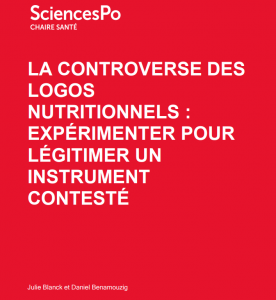
La controverse du Nutri-Score : expérimenter pour imposer un logo contesté par Julie Blanck, sociologue à Sciences Po

The sociologist Julie Blanck (Sciences Po) will present her research report “The Controversy over Nutritional Logos: Experimenting to Legitimize a Contested Instrument.” Abstract: On July 8 and 9, 2017, two journalists from Le Monde published an investigation into conflicts of interest surrounding the selection of a nutritional front-of-pack label. Their article criticizes a real-life purchasing experiment conducted to compare four nutritional logos—Nutri-Score, SENS, Nutri-Couleur, and Nutri-Repères. They recount the history of this new public policy instrument, its development, and the strong opposition from economic actors—industry and retailers—who reject a “stigmatizing” label and mobilize to prevent its implementation at both European and national levels. The journalists particularly denounce the composition of the committees in charge of the experiment and the choice of operational partners: according to them, “conflicts of interest cast doubt on the impartiality” of the study. The steering committee included representatives from industry and retail groups. It entrusted the operationalization of the study to the Fonds Français pour l’Alimentation et la Santé (FFAS), presented as a form of “scientific lobbying organization,” funded by industry to strengthen ties between academics and economic actors. This proximity to industry also appears in the scientific committee responsible for designing the experimental protocol, as several researchers allegedly had links “with industry,” which reportedly led three researchers to “resign with a bang.” A topic previously handled discreetly within negotiation arenas involving policymakers, scientists, economic actors, and consumer associations suddenly became highly mediatised. Throughout the experiment, journalists from the national press closely followed the process, reporting its developments to the general public.
event

18 June 2025

la Maison des Sciences Sociales et des Humanités de Dijon.

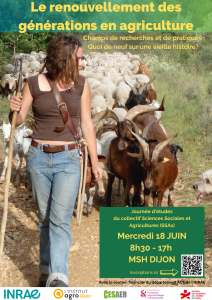
Le renouvellement des générations en agriculture. Champs de recherches et de pratiques : Quoi de neuf sur une vieille histoire?

Une journée d'études intitulée "Le renouvellement des générations en agriculture. Champs de recherches et de pratiques : Quoi de neuf sur une vieille histoire?" est organisée le mercredi 18 juin à la Maison des Sciences Sociales et des Humanités de Dijon.
event

21 October 2025

SEMINAIRE | CESAER | GS. LONGELLES

DES ÉLUS EN CAMPAGNE Luttes municipales dans les bourgs industriels (XXe-XXIe siècle) Presses de Sciences Po, 2025

Dans le cadre du séminaire SSP, le sociologue Julian Mischi présentera son dernier ouvrage, qui propose une autre histoire politique des petites villes à travers les élections municipales, entre construction et contestation d’un ordre social local. --- Extrait: Ce livre propose une autre histoire politique de la France contemporaine sous l'angle des élections municipales et des petites villes, entre construction et contestation d’un ordre social local. Lire la suite Gilets jaunes, essor de l'extrême droite, retrait des services publics… Les petites villes rurales sont devenues ces dernières décennies le symbole d’une France populaire qui souffre et proteste. La plupart ont en commun une histoire méconnue, celle de l’industrialisation des campagnes, qui, à partir du xixe siècle, a présidé au développement d’un peuplement ouvrier et à la formation d’une élite de notables tenant le pouvoir municipal. En Bourgogne, Brienon-sur-Armançon, Saint-Florentin, Venarey-les-Laumes constituent trois de ces bourgs. S’appuyant sur les archives locales et des sources orales, Julian Mischi restitue leur histoire politique qui, loin de l’image d’un apolitisme et d’un unanimisme rural, se révèle riche et conflictuelle, traversée par des oppositions et des alliances de classe : l’accession de militants issus de milieux populaires à la tête des mairies demeure exceptionnelle, tandis que la bourgeoisie commerçante et industrielle parvient à maintenir hors du conseil municipal des populations ouvrières, pourtant majoritaires. Se dessine alors une autre histoire politique de la France contemporaine sous l’angle des élections municipales et des petites villes, entre construction et contestation d’un ordre social local.
event

18 November 2025

SEMINAIRE | CESAER | GS. LONGELLES

QUARTIERS POPULAIRES Défaire le mythe du Gheto Amsterdam, 2024, CRESPA CSU / Univ. Paris 8

PIERRE GILBERT présente son ouvrage et en voici un extrait: « Voir les cités autrement permet de s’émanciper d’une vision qui considère le peuplement comme le principal problème et qui fait du bulldozer et de la grue les principaux instruments du changement social. »
event

25 September 2025

SEMINAIRE |CESAER | GS. LONGELLES

LE CAPITALISME AU VILLAGE Pétrole, État et luttes environnementales en Amazonie CNRS éditions, 2023

Réporté / Doris Buu-Sao Maîtresse de conférences en science politique à l’université de Lille, travaille sur les industries extractives, en Amérique latine et en Europe nous présentera son ouvrage LE CAPITALISME AU VILLAGE Pétrole --- Extrait: Le 5 juin 2009, après plusieurs mois de contestation d’une loi favorisant l’extraction de ressources naturelles, des affrontements éclatent entre policiers et manifestants indiens dans le nord du Pérou. Plusieurs dizaines de personnes y trouvent la mort. Dans l’après-coup de cet épisode de violence, cette enquête novatrice sur l’exploitation de la nature en Amazonie explore les rapports entre l’industrie pétrolière, les communautés indigènes et le pouvoir péruvien. Elle invite à rompre tant avec les lectures romantiques célébrant l’héroïsme de la résistance indienne qu’avec le regard désabusé de celles et ceux qui déplorent l’incapacité d’un peuple à reprendre en main son destin. Car celui qui défile pour la Fédération quechua, sous l’œil des caméras, armé d’une lance et le visage couvert de peintures de guerre, peut bien réapparaître quelques jours plus tard comme travailleur du site pétrolier, vêtu d’un uniforme semblable à celui des ouvriers venus de Lima. Pour restituer cette complexité, l’ouvrage met en lumière le déploiement de l’État et du capitalisme « par le bas ». Le temps long de l’observation révèle la variété des interactions entre les villages autochtones et l’industrie pétrolière, et permet d’éclairer la manière dont l’ordre politique et économique est produit mais aussi contesté au quotidien.